
|
|
|
|
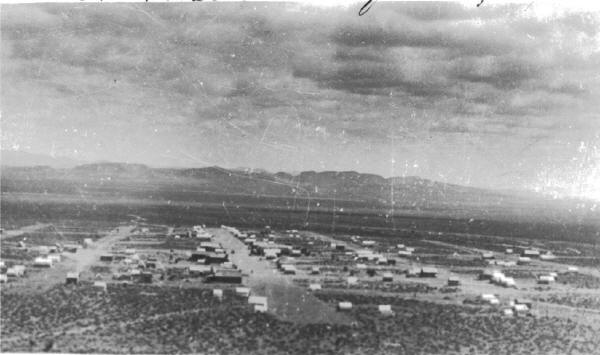
April, 24 1908
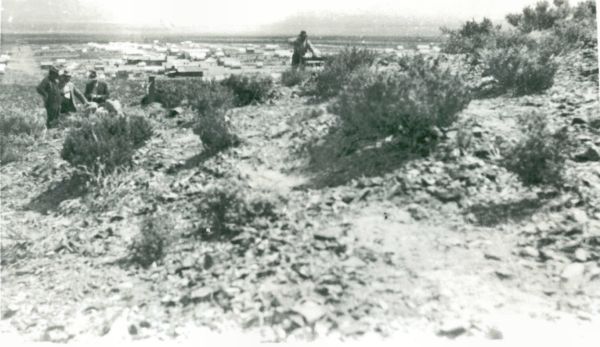
A few hundred yards west of the present day townsite is an outcropping of limestone. A "tent city" was here mining silver ore and the miners christened the site Lime Point. This small collection of tents and miners soon disappeared into the untold pages of history.
It is not sure of what happened to these early settlers of 130 years ago.
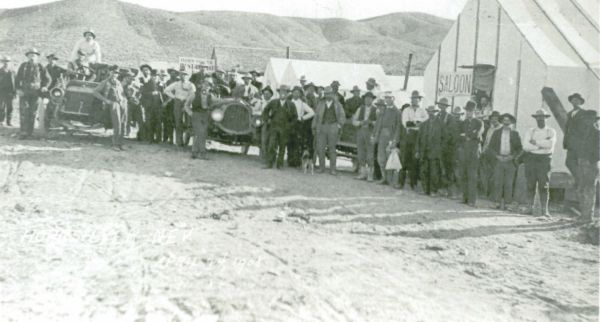
1908
What IS known is that supplies and water were scarce and Indians were not. This was a very desolate area in those days. The only major supply town was about 250 miles north at a town called Unionville, a major mining town northeast of present day Lovelock.
At that time, the cost of freight was over $100.00 a ton and delivered by horse drawn wagons. Water was conveniently closer, being only a day's ride by horse and wagon, in Lida Valley, 12 miles northwest.
Around 1880, better silver outcroppings were discovered and mining resumed, with the precious metal selling at almost $1.00 per ounce.
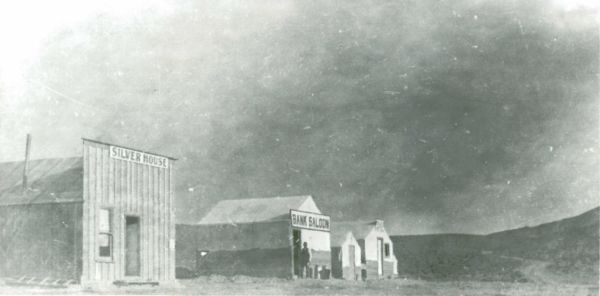
June 1908
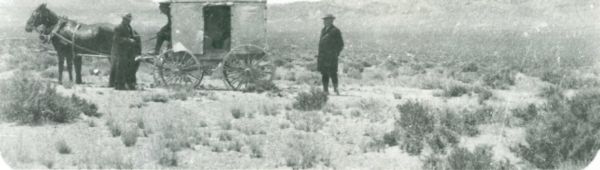
Hornsilver/cuprite state.
Picture is about halfway between
the towns
heading for Hornsilver.
The scarcity of water meant that the ore had to be shipped to nearby Lida for milling. The town of Lida had been established a few years earlier in 1872 and was equipped with several of the dearly needed variety stores and shops. Along with livery and feed stables, there was even a post office.
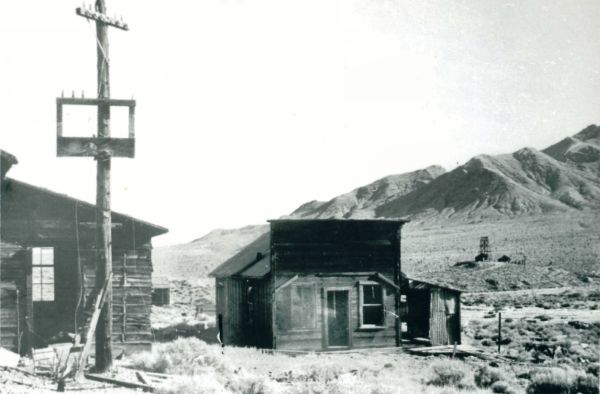
The old hornsilver townsite and
telephone building back
in 1974
before moving it to it's present place
and making it our saloon
Most important of all, were two steam powered stamp mills at the nearby springs to crush the ore. One was equipped with five stamps and the other with eight.
The huge costs of shipping the ore to Lida and milling it, coupled with the remoteness to any railroads, led to virtual abandonment of operations and the town of Lime Point in 1882.
It wasn't until 20 years later, after the turn of the century, that new discoveries of rich deposits of silver and gold established the major mining towns of Tonopah and Goldfield. Ttyhis brought about 40,000 people to the area and some went back to the older mining areas of the past such Lime Point.
Hornsilver June 1908
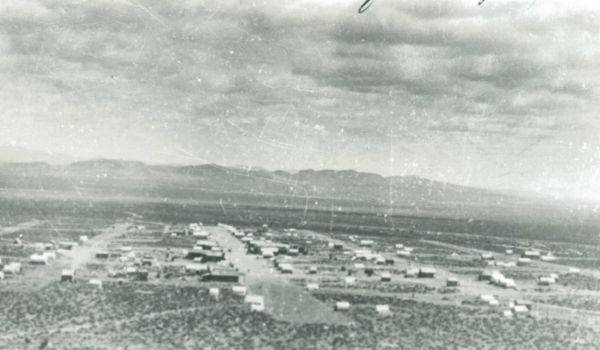
In 1905 about a half mile southeast of the old tent city of Lime Point, the Great Western Mine began operations. After discovery of high-grade silver ore known as Hornsilver, a feverish stampede developed and the new camp of Hornsilver was founded.
Gold was also mined in limited quantities.
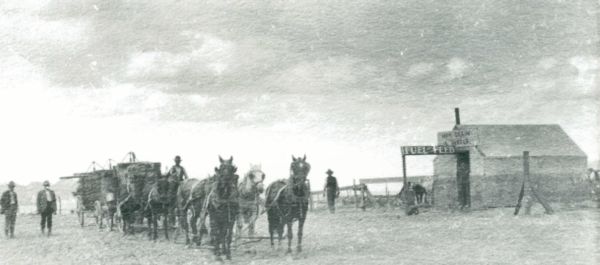
June 1908 in M.A Maher's yard
In May of 1908, a newspaper, the Hornsilver Herald, began publication. The following week a post office was established. Soon a Chamber of Commerce was organized and a railroad projected.
The railroad never puffed smoke any closer than 15 miles to the east at Ralston. The Bullfrog - Goldfield and the Tonapah - Las Vegas were the two major Railroads in the area.
Hornsilver June 1908
From the railroad depot at Ralston, you could get an Auto-stage to Hornsilver for $5.00.
Supplies were also sided there and were shipped to the growing town. At the peak of prosperity, with a peak population of around 1,000, there were over 225 wood-framed buildings, tents and shacks throughout the town site.
This included 13 saloons to keep the miners amply supplied with liquid libations.
Hornsilver June 1908
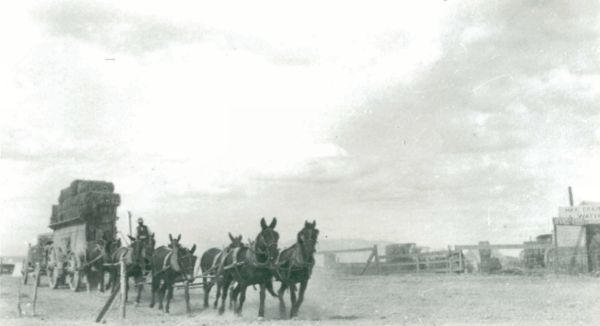
Mat Maher's freight wagon
Deep ore bodies were extensively developed until 1909, when litigation due to claim jumping, brought many mining properties into the courts, like a lot of mines of the early west. Inefficient milling practices in conjunction with claim jumping had made mining unprofitable.
In about 1915, mining operations resumed at Hornsilver.
Charles Stoneham, of the New York Giants baseball team, purchased the Great Western mine in 1922 at a receivers sale. This mine was Hornsilver's greatest producer, with a recorded production of over $500,000. This was with the price of gold at $20.00 an ounce and silver at 59 cents an ounce.
Ohio Mine and Mill circa 1940
Previously known as The Great
Western Mine
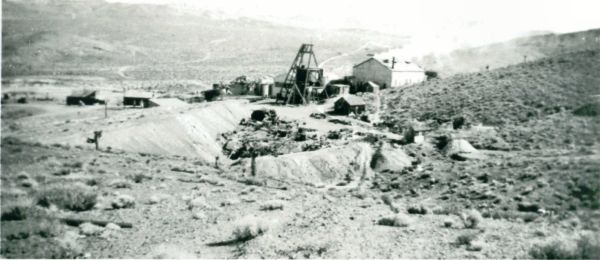
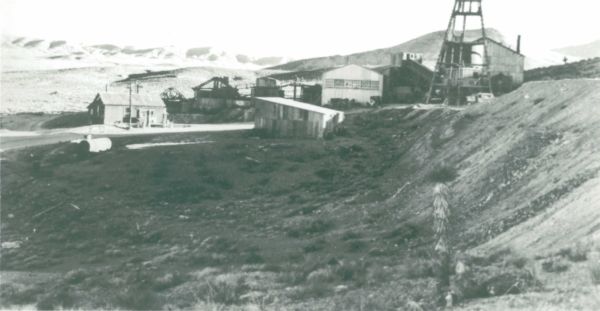
Mine Crew of February 1940
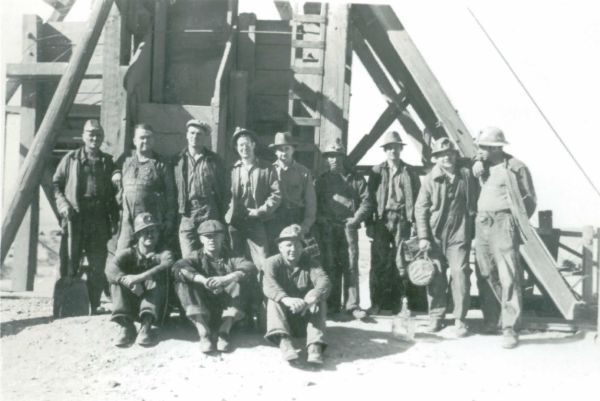
In 1927 a miner by the name of J.W. Dunfee went down the mine to look around and came up with a LARGE gold discovery. Within a few years, more gold than silver was being mined. To induce more growth and encourage investments, the name of the old camp was changed to its present day name of Gold Point.
Circa 1940's
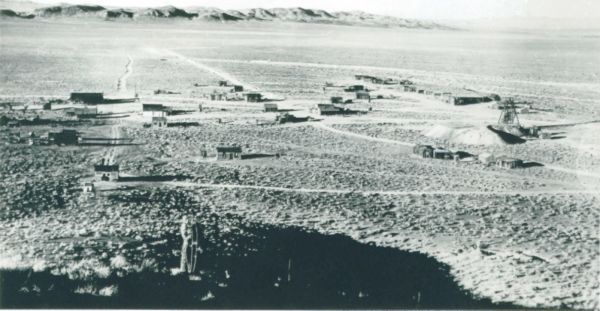
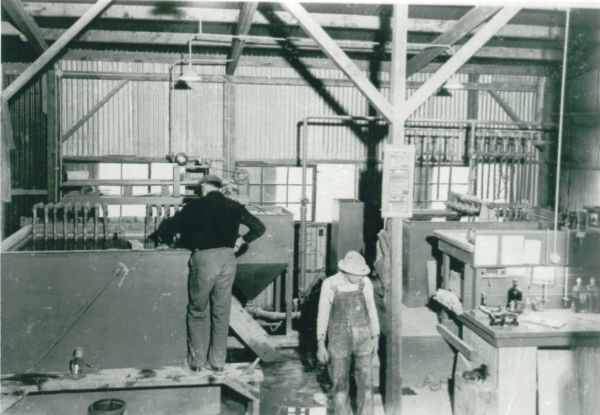
Inside Ohio mill February 1940
Since no strategic metals were being mined here when the United Stated entered the Second World War, workers went elsewhere and mining efforts ceased with the enactment of War Order L-208.
Ohio mill February 1940

After the war, mining resumed on a smaller scale. Since there was no water in any of the mines in Gold Point, it was an easy task reopening them. We were fortunate not to have the problems like they had in the California mines. In California's mines the water seeped in and the timbers became weak and rotten. This produced a tremendous expense to the mine owners and is why, along with higher prices for supplies and labor, most mines never reopened.
The fact
that gold prices remained at $35.00, ( gold went from $20.00 to $35.00 in
the 1930s) an ounce was probably the "straw that broke the camel's back".
Gold Point 1964
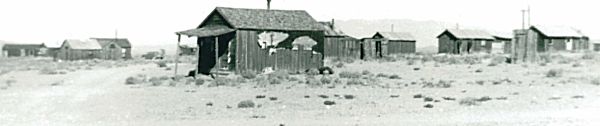
Mining continued up until the 1960's, when, at the 1000 ft. level
of the Dunfee Shaft, a dynamite charge went off wrong and caved a large part of the ceiling in. Rather than put out more money, on what had declined to a
marginal operation, they turned off the lights and closed the doors.
Other than an
occasional lessee here and there, this was the last serious mining operation in Gold
Point.
For the next 10 years, Gold Point was basically a Ghost Town and would have blown away piece by piece like so many other towns of the Old West had it not been for the loving and watchful eye of Ora Mae Wiley and her friends.
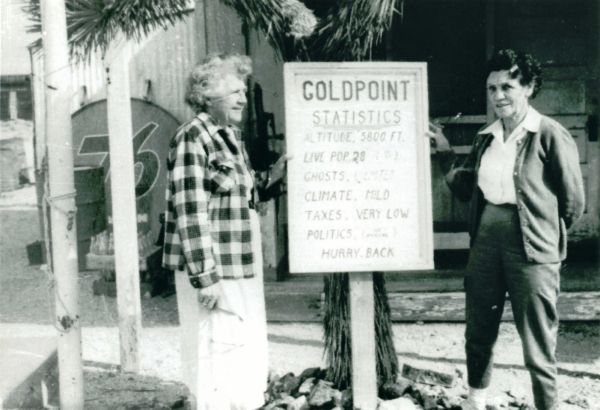
Ora Mae Wiley on left her friend
Mrs. Roberts on right.
She had come here around 1930 from Georgia to have a little look see. She met her future husband, Senator Harry Wiley, one of the founding fathers of Hornsilver, and stayed until her death, at the age of 83 in 1980.
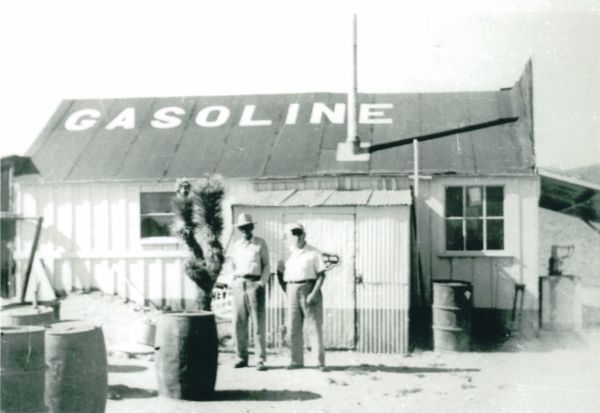
Picture taken the year sheriff stone was born-1951.
In addition to mining, Harry, (on the left) served on the Esmeralda County Board of Supervisors from 1940 until he was elected to the Nevada State Senate in 1946, where he served until his death in office in 1955.
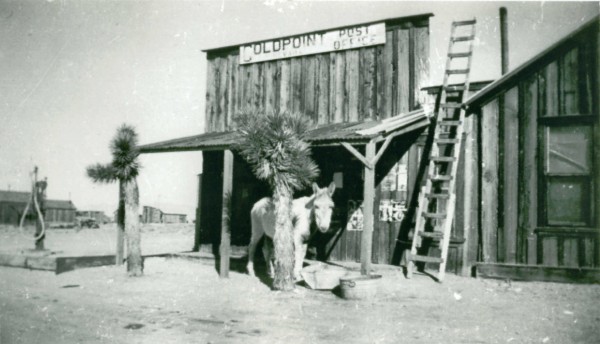
The couple also operated a little general store and a Standard Gas station. Ora Mae was Postmistress in Gold Point from 1940 to 1964. In 1967 the 4th class Post Office closed.
Slowly, a newer generation of Gold Pointers started moving into town. Today we boast of a population of 6 full time residents and as many as 6 part time.
Gold Point area June 16, 1986.
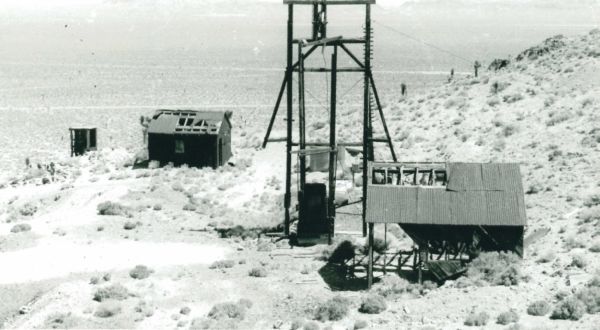
Buildings and headframe no longer standing.
There are a handful of other people who own property in Gold Point, but they are scattered around the U.S. and rarely make the trip out. There are a few others who live just outside the town limits also.

Mine buildings and headframe just outside of gold point in 1986,
Building
on left and the headframe have fallen since then.
Together, everyone watches out for everyone else and is the reason we have no problems in Gold Point. When you visit Gold Point you may not see anyone, but rest assured they are watching you.
Gold Point August 1975
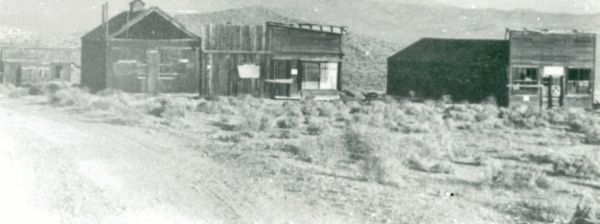
Mitchell's mercantile store on left
turf club and grill on right
both before restoration.
Restoration of some of the old buildings has been going on since the late 1970s.
Two museums are available to the public on most weekends.
Gold Point 1981
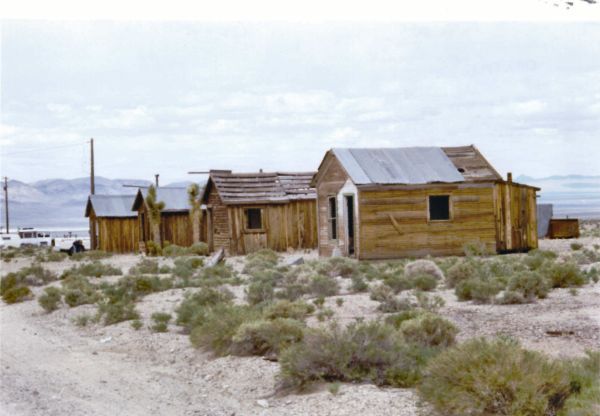
Building on right is
Hornsilver
bed and breakfast cabin
before being moved and restored.
Remember when visiting Gold Point, that all of the buildings, regardless of condition, and the artifacts, even the ones left scattered around and in the cactus and sagebrush, DO BELONG TO SOMEONE.
Please take only photographs and leave only footprints. Survivors of anyone
caught removing or vandalizing will be prostituted to the fullest extent!
We hope you enjoy visiting your heritage!
Herb, Walt and Sandy
GOLD POINT, NEVADA
Click Below to Go to:





|
Or |